Free IQ Test · Instant Results · No Sign-Up
Free IQ Test: Find Out Your Real Score
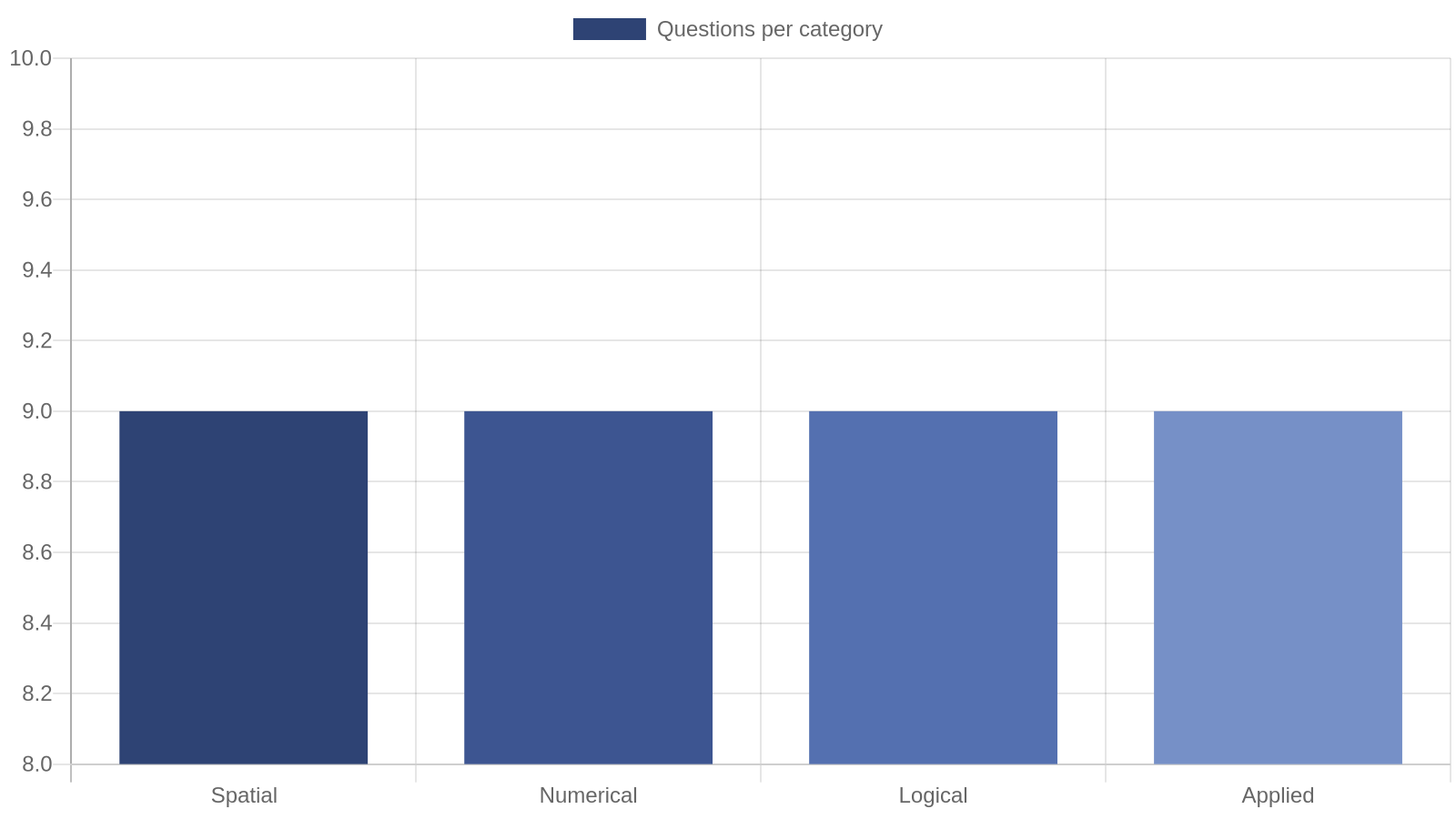
36 questions across spatial, numerical, logical, and applied reasoning. Your score, percentile, and full category breakdown — free, in 25 minutes, no account needed.
Free IQ Test · Instant Results · No Sign-Up
36 questions across spatial, numerical, logical, and applied reasoning. Your score, percentile, and full category breakdown — free, in 25 minutes, no account needed.
What Your Results Look Like
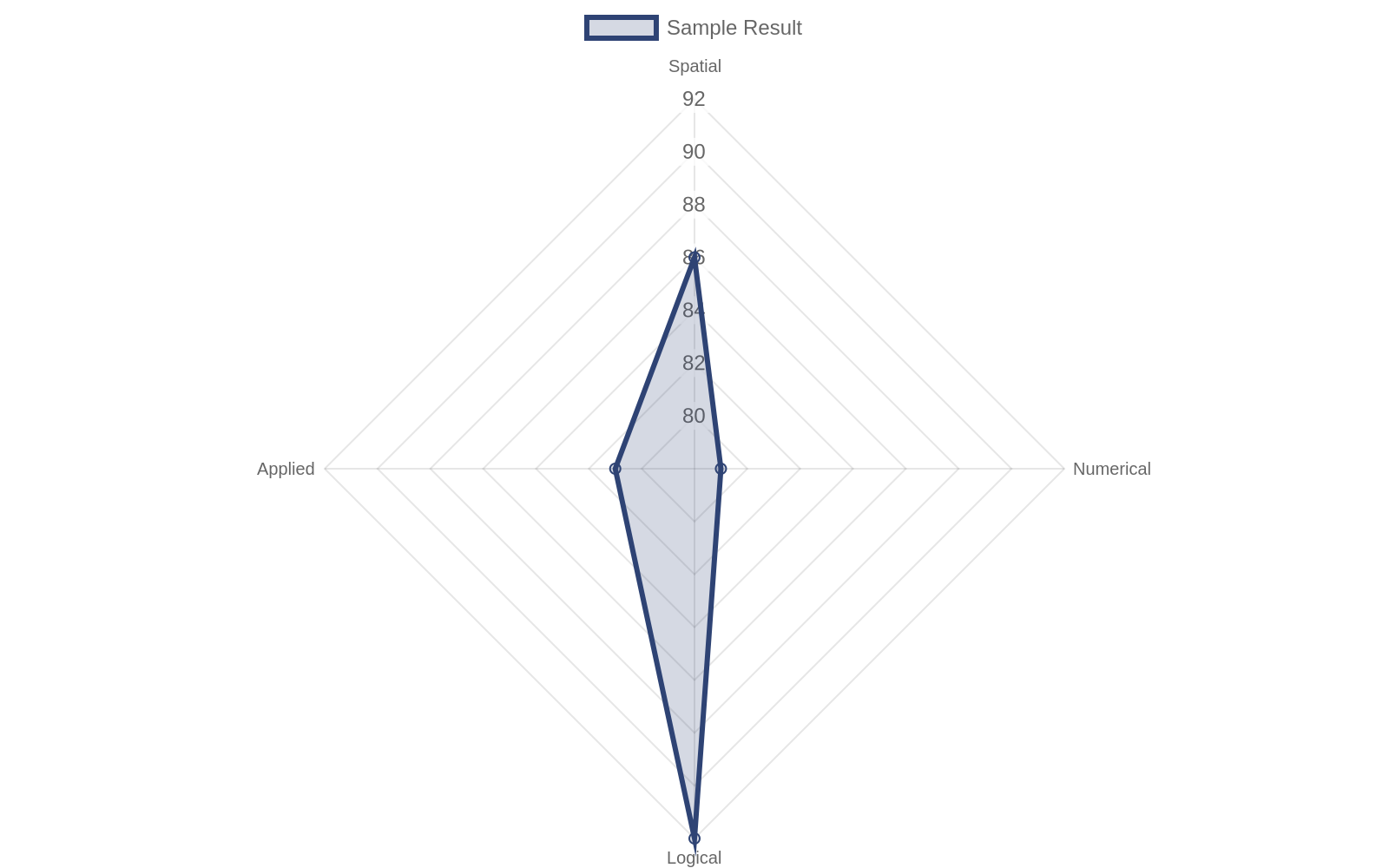
Most “free” IQ tests lock your detailed results behind a payment screen after you’ve already answered every question. Here, your composite score, percentile rank, and breakdown across all four categories appear the moment you finish — nothing hidden.
The result you see is genuinely the same one stored on our end, calculated from the same normal-distribution model described throughout this page. There is no separate detailed version reserved for a paid tier, and no follow-up email required to unlock the category breakdown — what you see immediately after finishing is the complete picture.
The Basics
An IQ test is a structured set of reasoning tasks designed to estimate general cognitive ability, scored by comparing your performance to a reference population on a standardized scale — mean 100, standard deviation 15, the same convention used by most modern cognitive assessments. This one measures four distinct domains rather than blending everything into a single number, so you can see not just your overall score but what’s actually driving it.
The term IQ itself is short for intelligence quotient, a name left over from when scores were literally calculated as a ratio of mental age to chronological age. Modern tests, including this one, no longer use that calculation — instead, your raw performance is converted onto a standardized scale by comparing it against everyone else who has completed the same assessment, which is what makes the resulting number meaningful and comparable across attempts.
It is built for informational and entertainment purposes, not as a clinical diagnostic tool — see our full methodology for exactly how scoring works and what it can and cannot tell you.
Question Design
Mentally rotating shapes and completing visual patterns — the skill behind map-reading, packing a suitcase efficiently, and reading engineering diagrams. It doesn’t depend on vocabulary, which makes it one of the fairer categories to compare across different educational backgrounds.
Spotting the pattern in a number sequence and predicting what comes next. No algebra is required — the skill being measured is fluid pattern recognition applied specifically to quantitative information, not memorized math procedures.
Working from a stated rule to a valid conclusion — matrix-style grids, odd-one-out puzzles, and if/then deduction problems. This is the category most people picture first when they hear “IQ question.”
Real-world scenarios combining logic with practical judgment, because abstract puzzle-solving ability doesn’t always translate cleanly into handling a messy, real situation with multiple competing constraints.
Built on Real Data
Your percentile is not a guess — it is calculated from the same normal-distribution model that scores every completed assessment, and that dataset grows with every test taken. Unlike a site that hard-codes a fixed percentile table once and never revisits it, the reference distribution behind your score reflects real, ongoing usage rather than a static assumption made years ago.
This matters because the whole point of a percentile is comparison against real people, not against a theoretical model alone. A live, growing dataset keeps that comparison honest as more people take the test over time.
The Scale
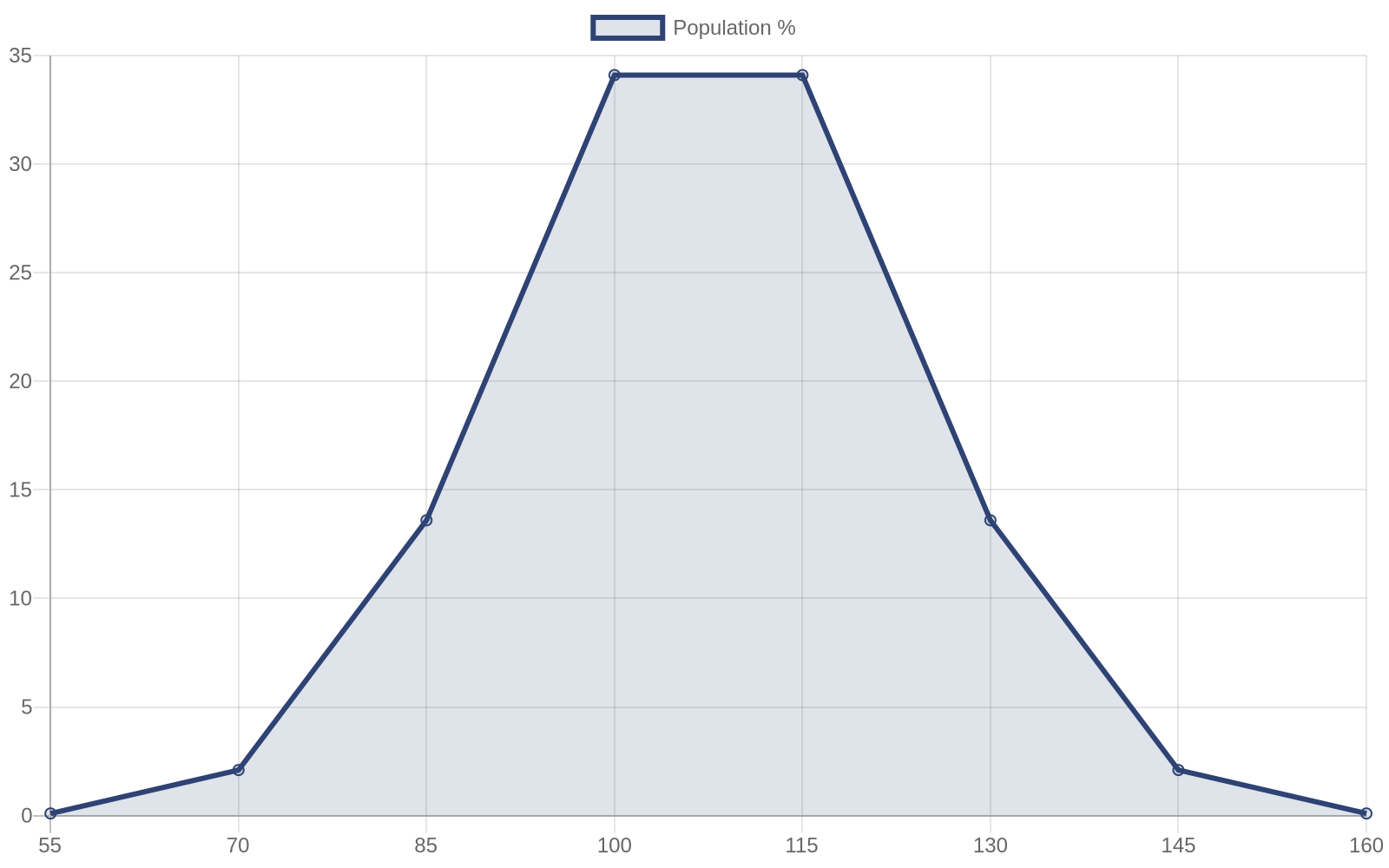
Every score is converted to this standard scale, so a 100 sits exactly at the middle, 115 clears roughly the 84th percentile, and 130+ lands in the top 2%. Half of everyone who takes a well-built IQ test lands in the 90–109 “average” band, which is exactly why average is the single most common outcome, not a disappointing one. The tails thin out fast from there — each additional 10–15 points further from the center represents a progressively rarer result.
| IQ Range | Classification | Approx. % of Population |
|---|---|---|
| Below 70 | Extremely low | ~2.2% |
| 70–89 | Low / borderline | ~22.8% |
| 90–109 | Average | ~50% |
| 110–129 | High average / superior | ~22.8% |
| 130+ | Very superior / gifted | ~2.2% |
Fairness & Design
Question wording avoids culturally specific references and idioms where possible, since a reasoning test should measure reasoning, not familiarity with a particular region’s slang or trivia. Spatial and numerical items in particular are built to be solvable through pattern recognition alone, without requiring outside knowledge.
This is the same principle behind culture-fair instruments like Raven’s Progressive Matrices, used specifically because they travel better across different linguistic and educational backgrounds than heavily verbal tests do. We also don’t inflate results for engagement — scoring here follows the standard normal distribution strictly, so most people land near 100, and the further from center a score sits, the rarer it genuinely is.
Common Questions
Built for informational and entertainment purposes, following the general structure and scoring conventions used by cognitive assessments — a normalized scale with a mean of 100 and standard deviation of 15, spanning spatial, numerical, logical, and applied reasoning. It is not a clinical diagnostic tool, and if you need a score for a clinical, educational, or professional purpose, a licensed psychologist administering a validated instrument is the correct route.
Most people finish the 36 questions in 20 to 25 minutes. There’s no per-question timer forcing you to rush, but the overall test is designed to be completed in one uninterrupted sitting for the most reliable result.
No. You can start the test and see your full composite score, percentile, and category breakdown without registering, logging in, or providing an email address anywhere in the flow.
The core test — your composite score, percentile, and full four-category breakdown — is entirely free, with no locked or partial results waiting behind a paywall.
No. There is no subscription, no recurring charge, and no card details are requested anywhere in the test flow, from start to seeing your result.
Your score reflects how you performed relative to everyone else who has completed this specific assessment, scored consistently on the same 100/15 scale used across most modern cognitive tests. Results can vary somewhat with focus and familiarity with test-style questions — for a clinically precise score, an in-person assessment with a licensed professional is more reliable than any online test, including this one.
Anything above 100 puts you above the statistical midpoint. In everyday usage, 110 and above is generally considered clearly above average, and 130+ (roughly the top 2% of test-takers) is where terms like very superior or gifted typically apply.
No. Mensa requires a score at or above the 98th percentile on a supervised, professionally administered test. No free or informal online test, including this one, is accepted as qualifying evidence — see our guide on Mensa testing for what actually does.
Yes, though it’s worth being aware of practice effects — your score on a second attempt with a similar format often rises simply from familiarity with the question types, not necessarily from a real change in underlying reasoning ability.
No account or email is required to take the test, so there is minimal personal data collected in the first place. See our privacy policy for full details on what, if anything, is stored during your visit.
Who Takes This Test
The same 36 questions and the same scoring model serve every visitor, because the underlying goal is identical regardless of why you’re here: an honest, well-explained estimate of your current reasoning performance. What changes is what you do with the result afterward.
Just want to know where you stand, no specific goal beyond that. What is a good IQ score?
Preparing informally for a cognitive component of an entrance exam or application process. How to prepare for a test
Curious about a child’s reasoning development, understanding a formal assessment is the right next step for anything official. IQ testing for kids
Building a realistic baseline before investing time and money into a formal, supervised qualifying session. Mensa IQ test explained
How We Compare
“Free IQ test” covers a huge range of quality online, from genuinely well-built assessments to thin quiz pages designed mainly to collect an email address before showing you anything real. The differences rarely come down to the underlying math — most tests use the same widely accepted 100/15 scale. What actually separates a good test from a weak one is everything around it.
A few warning signs are worth watching for on any test you evaluate: a locked or partial score after you have already finished answering, a single blended number with no category breakdown, and no explanation anywhere of how scoring actually works. None of those describe a well-built assessment, regardless of which site it is on.
| bestfreeiqtest | Many other free tests | |
|---|---|---|
| Full score shown free | ✓ | Sometimes |
| Results shown instantly | ✓ | Sometimes |
| No email required | ✓ | Often not |
| 4-domain breakdown | ✓ | Rarely |
| Extra cognitive mini-tests | ✓ | Rarely |
Methodology
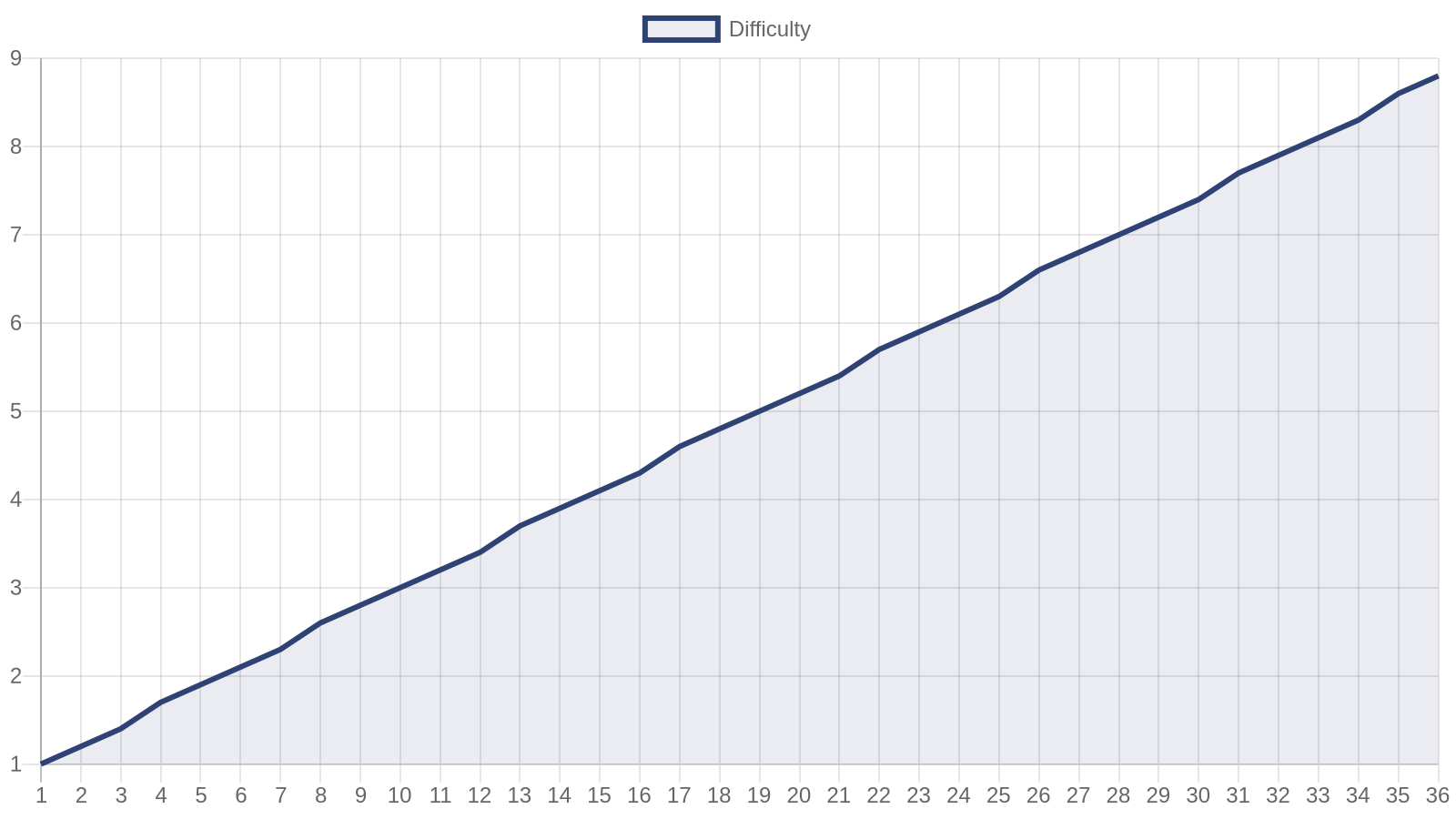
Difficulty increases progressively through the 36-item sequence — early questions confirm you understand the format, later ones separate strong performance from average. Your percentile is calculated against a real, growing dataset, not a fixed lookup table.
This mirrors how professional cognitive instruments are structured: a deliberate progression from easy to hard, rather than a flat difficulty level throughout. A test where every question is equally easy can’t meaningfully separate an average performance from an exceptional one, which is exactly the gap this progression is designed to close.
None of this makes the test clinically equivalent to a professional, supervised instrument administered by a licensed psychologist — we say that plainly throughout this page and in our full methodology. What it does mean is that the estimate you get is built on sound statistical footing rather than being an engagement gimmick dressed up as a cognitive assessment.
None of this makes the test clinically equivalent to a professional, supervised instrument administered by a licensed psychologist. What it does mean is that the estimate you get is built on sound statistical footing rather than being an engagement gimmick dressed up as a cognitive assessment.
Read This Before You Share Your Score
An IQ score is genuinely useful information about your performance on a specific, well-defined set of reasoning tasks. Research shows a real, moderate correlation between IQ and outcomes like job performance in cognitively demanding roles, but it’s a much weaker predictor of things people often assume it captures — creativity, emotional intelligence, practical judgment, or overall life satisfaction.
It’s also not fixed in stone. Measured scores shift with sleep, familiarity with test-style questions, and general test-day conditions, which is exactly why we recommend reading any single result as a solid estimate within a reasonable range, not an exact, permanent number carved in stone.
No account. No wait. No catch.
Learn More